
Why Your 50-Person Shop is Losing Margin to a Whiteboard and a Gut Feeling
Stop losing profit to inefficient scheduling. Learn why manual whiteboards and spreadsheets fail as your shop grows and how to reclaim your margin today.
Why your 50-person shop is losing margin to a whiteboard and a gut feeling.
Walk into any 50-person shop and ask about scheduling. You'll get an earful. About the late jobs. About the spreadsheets stacked on top of spreadsheets. About the software that almost does it. About the dispatcher who's the only person who can actually make it work, and what happens when she takes a week off.
People talk about this problem constantly. They just talk around fixing it, because the fixes they reach for — a new calendar app, another spreadsheet column, hiring another dispatcher — don't actually address what's broken.
And the current setup works. Sort of. Until it doesn't. Everyone has their workarounds and they hold up until something shifts. A new customer with tighter delivery windows pushes the dispatcher past her mental capacity. Or a key person leaves and the tribal knowledge walks out with them.
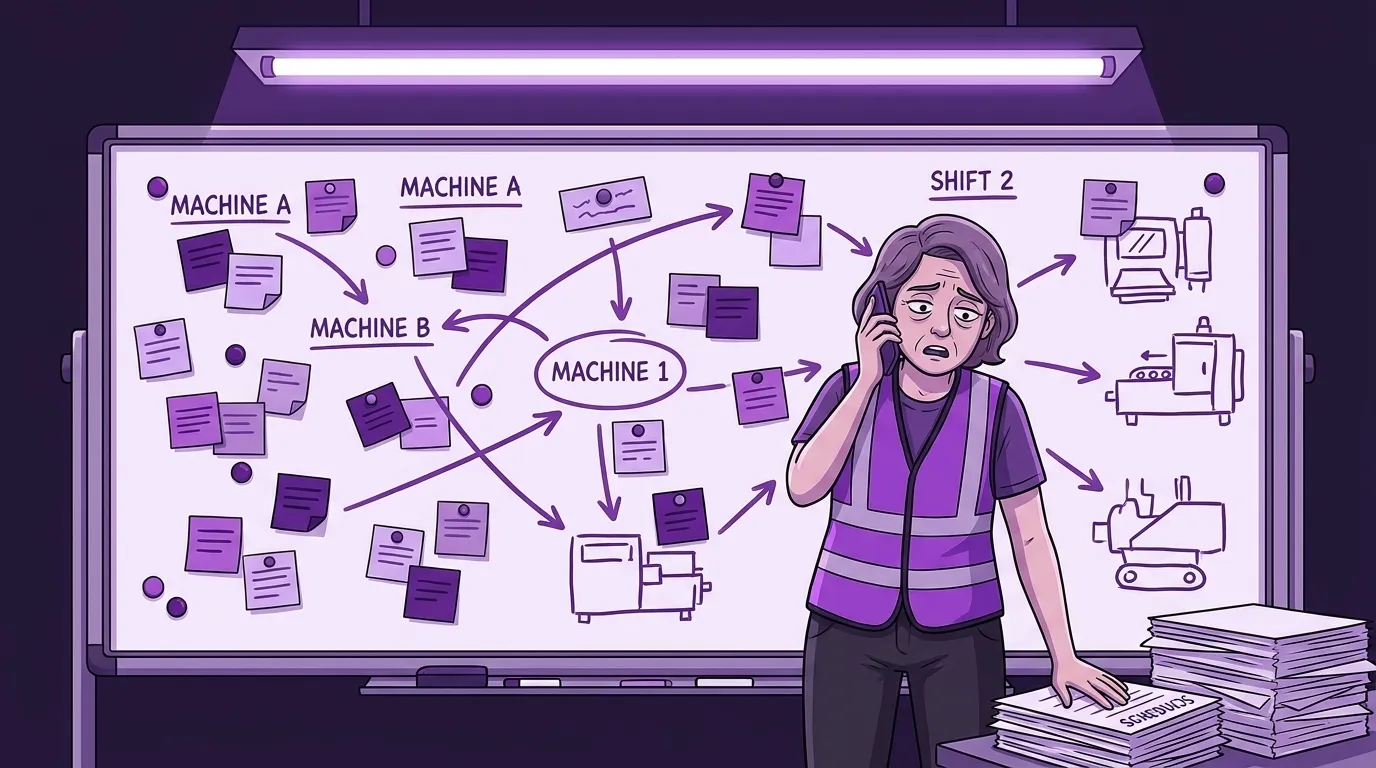
The reason the problem keeps showing up isn't that you don't have the right tool. It's that the math underneath scheduling is structurally beyond what a human brain can hold in working memory once your operation crosses a certain complexity threshold — and that threshold is lower than most people think.
The Simple Case Works. The Real Case Doesn't.
Scheduling looks easy from the outside because the simple case actually is easy. One person, one machine, a list of tasks in order. You can lay it out on a calendar and the math fits in your head. Pick the next job, do the next job, move on. That's where most operations start, and it's why the whiteboard hangs on for years — as long as the constraints stay simple, the visual approach works fine.
Then the variables start showing up. Each one looks innocent on its own.
You add a second machine. Now you've got two parallel timelines and you need to decide which job goes where.
You add operator skill levels. Now the same job takes different amounts of time depending on who runs it, and "whoever's free next" stops being the right answer.
You add setup costs. Now the order of jobs matters as much as the assignment, because running similar work back-to-back saves you 90 minutes per switch.
You add a multi-part customer order that needs to ship together. Now there's a grouping constraint that fights with the batching constraint you just added.
Each variable, in isolation, you can reason through. Stack them, and the number of possible schedules explodes into territory where two things are simultaneously true:
Working through every possibility is too expensive. Even for a modest operation — say 50 jobs across 8 resources — the number of valid schedules runs into the billions once you layer in skill matching, setup costs, dependencies, and time windows. Your dispatcher isn't computing this. She's sampling a handful of plausible plans from a much larger space she can't see.
Not working through them costs you margin. The difference between a good schedule and a great one is rarely visible job by job. It shows up in aggregate — 12% more overtime, 8% lower utilization, an extra setup per shift that nobody notices because each individual decision looked reasonable at the time.

That's the trap. The simple-way approach doesn't fail loudly. It fails by leaving money on the table at every shift change, in amounts small enough to attribute to "that's just how this week went."
None of this means the alternative is easy. Solving the real version of the problem is genuinely hard — that's why it doesn't get solved. The point is just that the simple way has a clear breaking point, and most operations are well past it without realizing it.
The Constraints That Kill Your Margin
Here are the scheduling dimensions that most SMBs handle with gut instinct — and get wrong often enough to feel it on the P&L.
Setup and Changeover
A paint line switching from red to white loses 90 minutes to cleaning. A CNC machine changing fixtures loses 30 minutes between jobs.
The optimal move is to batch similar work together — run all the red jobs, then switch to blue. But that conflicts with the next constraint.
Order Grouping
A customer order has eight parts across three colors. Ship them together and the customer's happy. But batching by color for efficiency means the order might span three days instead of one. Now you've got a customer calling about a partial shipment.
This is a genuine tension. Batching for efficiency vs. grouping for customer experience. Your dispatcher resolves it by instinct, and they're probably leaving 15–20% of the optimization on the table because no human can evaluate all the tradeoffs simultaneously.
The Proficiency Trap
Three welders can all do TIG welding. On paper, they're interchangeable. In reality, your expert does the job in two hours, your mid-level in two and a half, and your apprentice in three. Multiply that across a week of assignments and you're looking at a 30–40% spread in labor hours depending on who gets what.
The manual scheduling instinct is to assign whoever's free. The smart move is to assign the expert to the critical-path job and the apprentice to the one with slack. No human dispatcher is running that calculation across fifty tasks and ten people in real time.
Multi-Resource Coupling
A CNC job needs both the machine and a qualified operator. A field install needs a truck and a two-person crew. A surgery needs a room, a surgeon, an anesthesiologist, and a nurse — all simultaneously available.
Finding a single resource's open slot is easy. Finding a time window where three or four resources are all free, all qualified, and all in the right location? That's where the combinatorial explosion gets real. Every additional resource requirement multiplies the search space.
The Lag Nobody Accounts For
After painting, parts need four hours to cure before the next operation. After pouring concrete, 24 hours. The resource — the paint booth, the crew — is freed immediately. But the next task in the dependency chain can't start yet.
This is different from setup time, which consumes the resource (the booth is being cleaned). Lag time frees the resource but blocks the successor. Most scheduling tools conflate the two and quietly mis-plan everything downstream.
Travel and Location
For field service, mobile install, home health — half the schedule is travel time. Two jobs that look back-to-back on the calendar might be 40 minutes apart in the truck. Optimizing routes alongside assignment is a whole second layer of math layered on top of everything above.
When Things Go Wrong (And They Will)
Even a perfect schedule survives about an hour into the morning. Someone calls in sick. A machine throws an error. A customer pushes a delivery up by two days. A part doesn't arrive.
This is where the whiteboard really breaks down. The dispatcher now has to mentally re-solve the whole puzzle on the fly, usually under pressure, while answering the phone. The result is almost always a locally reasonable patch that creates a downstream mess nobody sees until Thursday.
A system that helps you operate — not just plan — shows the dispatcher three alternative recovery plans in seconds instead of forcing them to spend forty minutes on the phone rearranging the day.
That's the difference between a system that helps you plan and a system that helps you operate.
What This Means for SMBs
You don't need to be a Fortune 500 manufacturer to have a scheduling problem worth solving. If you have more than ten schedulable resources, more than a couple of skill categories, any setup or changeover cost, and customers who care about delivery timing — you have a problem that a whiteboard can't optimize.
The businesses that figure this out gain compound advantages: tighter delivery windows, lower overtime, higher resource utilization, less setup waste, happier customers, and operations teams that spend their time managing exceptions instead of building schedules from scratch every morning.
The ones that don't keep hiring dispatchers and wondering why margin isn't improving with scale.
Keywords
Related Articles
How a 40-Person Company Runs Like a 100-Person Company
Stop letting value leak out of your business. Learn how to build systems that amplify your team's ta...
Your People Are the Integration Layer (And It's Costing You Everything)
Is your team acting as human middleware? Discover the 6 hidden patterns of integration failure costi...
Scattered Data Across Multiple Systems Is Making It Impossible to Get the Insights You Need
Discover how disconnected data across your business is costing you time & money. Learn to identify h...