
How a 40-Person Company Runs Like a 100-Person Company
Stop letting value leak out of your business. Learn how to build systems that amplify your team's talent and help your 40-person company run like it has 100.

The best small companies I've worked with don't feel small when you're inside them.
You call, someone knows the answer. You ask for a quote, it comes back the same day. You bring up a job from three years ago, they pull up the full history — revisions, documentation, decisions — without putting you on hold. From the outside, it looks like they have departments. Dedicated people for everything. A machine behind the curtain.
Then you find out it's 20 people. Or 40. And you wonder how.

The answer is never "they work harder." Hard work is table stakes. The answer is that somewhere along the way, they figured out what makes them valuable — and then they built a system that makes sure none of that value leaks out.
This isn't an article about fixing what's broken. It's about what happens when a company stops operating at its size and starts operating at its capability.
The Amplifier, Not the Instrument
I'm a synth guy, so forgive the metaphor — but this is the clearest way I know to explain it.
A great amplifier makes a great player sound incredible. It doesn't teach anyone to play. You can buy the best amp ever built and it won't help you if you don't know your instrument. But a great player through a bad amp? That's talent being wasted. Signal getting lost. Notes that should ring out getting swallowed before they reach anyone.
That's what's happening at a lot of 40-person companies. The talent is there. The knowledge is there. The competitive advantage is there. But the system they're running on — or the absence of one — is swallowing the signal.
The companies that punch above their weight aren't better because they have better software. They're better because they understood their product, understood the value the customer receives, and then used technology to make sure that value gets delivered at full volume. Every time. Without depending on heroics.

It's not about better software. It's about a better company.
30–50% More Revenue. Same Projects. Same Client.
Years ago I worked at The Kernel Group, a consulting firm. We worked alongside other consultants on the same IBM projects — same client, same building, sometimes the same deliverables.
We made 30 to 50 percent more per consultant than the other firms.
We weren't dramatically better engineers. We charged slightly more per hour, but not enough to explain that gap. The difference was capture.
We tracked our work the way lawyers track theirs — every hour accounted for, every task logged. But here's the thing: we didn't do it through discipline or nagging. We built tools that integrated directly into the workflow. Change to the directory where you're working on a project, and time is automatically logged. You didn't have to stop what you were doing, open a timesheet, and reconstruct your day from memory. The system knew where you were working because it was part of the work itself.
The result was almost 100% duty cycle — consultant time billed to the client versus absorbed by the company. And we captured all the small stuff that most firms let slide. The fifteen-minute conversation about a design problem. The half-hour spent reviewing someone else's code. The quick config change that "only took a minute." That small stuff, in aggregate, can easily be 20% of a consultant's week. On a fixed-bid project, the difference between capturing it and not capturing it is the difference between profit and loss.

When the engineers first saw the tooling, the reaction was predictable — it felt like big brother. A pain. But once they actually experienced it, the reality was the opposite. My time tracking at the end of the week was a 15-minute review. That's it. The system had already done the work. I just confirmed it.
The other firms had the same talent. The same client. The same projects. They just didn't have a system that made sure the value they created actually showed up on the invoice.
The Company That Knows More Than Its Customers
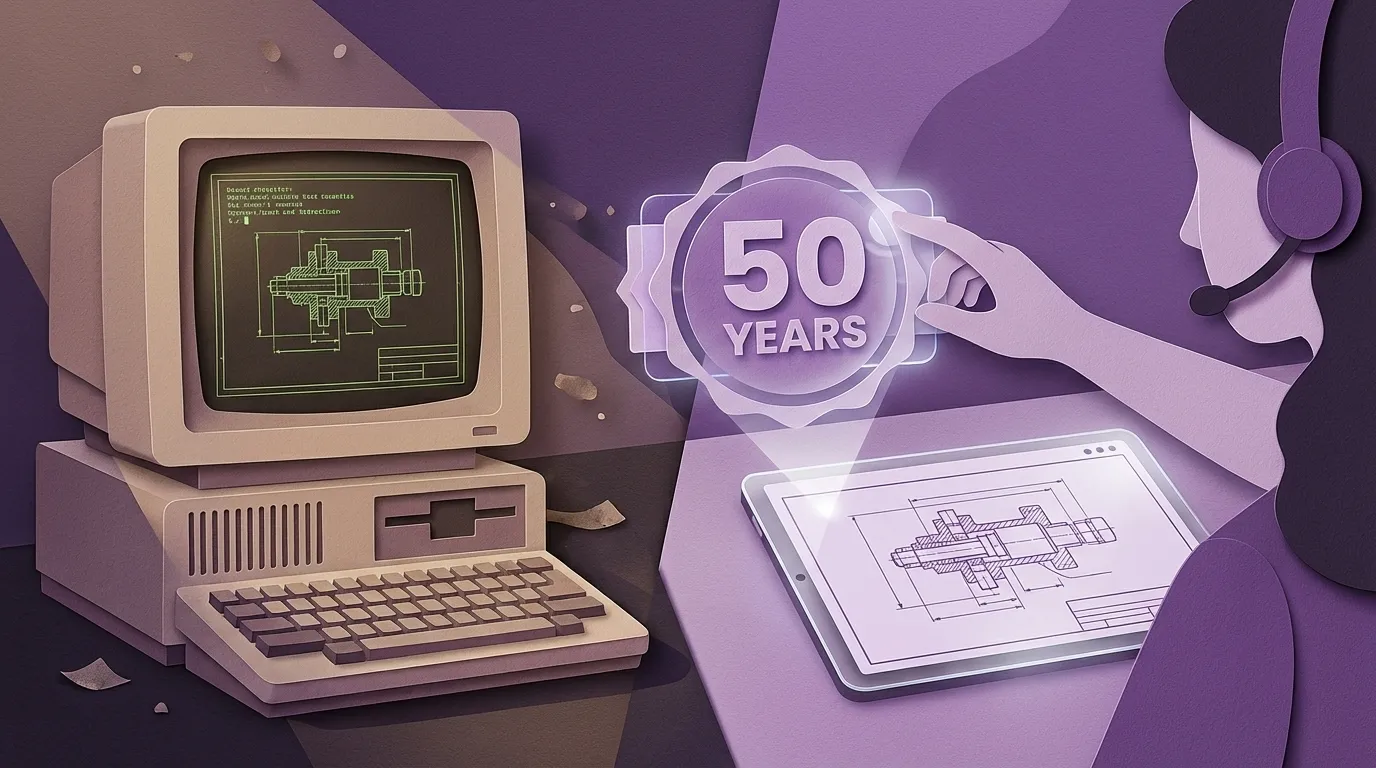
One of our clients is a 15-to-20-person precision manufacturer. They make custom cutting tools for hydraulic and pneumatic parts. They've been at it for fifty years.
When we started working with them, they were running an ERP system built in the 1980s. The last update was 1997. Only a couple of people left in the country understood how it worked. Training new staff on it felt like teaching a dead language.
But here's what most people would miss: this company wasn't suffering because of that old system. They were succeeding in spite of it — and the reason they kept using it for decades tells you everything about what makes them dangerous.
They knew more about the history of their clients' machines than their clients did. Every revision, every specification change, every engineering decision — documented, matched, accessible. When a customer called about a part they ordered years ago, they could pull the full history. The customer often couldn't do the same from their own records.
That institutional knowledge is why large companies keep coming back to a 20-person shop when there are much bigger manufacturers they could use instead. The engineering depth is the product. The data is the system.
When we replaced the 1980s software, the goal wasn't to modernize for the sake of modernizing. It was to preserve that advantage and make it accessible to everyone in the company, not just the two people who could navigate a 40-year-old database. We actually had to read source code from the 80s to decipher the data structures — because without the data, there was no point building anything. The data was the reason they'd held onto a system that hadn't been updated since Clinton's first term.
Now that knowledge lives in a system any employee can use. New hires don't need a months-long apprenticeship in legacy quirks. Remote work went from impossible to routine. And the competitive moat — knowing more about the customer's equipment than the customer does — got wider, not narrower.
I know much larger shops that will not get their business anytime soon.
They Forgot They Grew
There's a ceiling that hits most companies somewhere between 35 and 40 people. It's well known but rarely talked about in terms of what actually causes it.
At 8 to 12 employees, the CEO can be an octopus. One person with a handful of "managers" — really just senior doers — and the whole company operates on direct communication. Everybody knows what everybody else is working on. Decisions happen in hallway conversations. The owner's brain is the system, and it works.
Then the company grows. And the thing that made it successful at 12 — the founder's direct involvement in everything — becomes the thing that holds it at 40.

The company doesn't hit a crisis. It just stops scaling. Every decision still requires the same meeting. Every answer still routes through the same two people. The owner feels busier than ever but can't point to what changed. What changed is that the informal system they never had to think about has quietly maxed out.
These companies didn't fail. They forgot they grew.
Breaking through that ceiling always requires a system. Sometimes it's the discipline of a great ops hire. Sometimes it's software. Usually it's both. But it's always a system — a way for the business to operate that doesn't depend on one person's memory and availability.
When I hear an owner say "I just need a COO," what I often hear underneath is "I want to hire someone to look into my business because I don't think I can." You can. The problems will be loud. The solutions may not be obvious yet. But the path will be visible once you start looking — and starting with a solution before you've looked is how you end up with a COO you don't need or an ERP that doesn't fit.
Two Techs, Two Job Sites, Thirty Wasted Minutes
Not every leverage story is an enterprise-scale transformation. Some of the best ones are absurdly small.
A city-wide service company we worked with had a simple problem: when a field job ran over or under the estimated time, nobody knew until the tech was already done. Meanwhile, another tech might be fifteen minutes away from the first tech's next job — but dispatch didn't know that either. So two techs would drive past each other, both heading thirty minutes in opposite directions, both arriving late.
The fix was one capability: when a job went over or under, the tech checked in, and dispatch could reroute in real time. That's it. No AI. No dashboard. Just visibility into what was actually happening in the field, updated as it happened instead of reconstructed after the fact.
The windshield time that evaporated turned into on-time arrivals, which turned into more jobs per day, which turned into revenue. From one feature that made existing information available at the moment it mattered.
That's leverage. Not more people. Not more effort. Just less waste in the signal path.
One Percent or Twenty Percent
Here's the number that should change how you think about this.
A 40-person company can make 1% net profit or 20% net profit. Same headcount. Same market. Same basic offering. The difference isn't talent — both companies have good people. The difference is how much of the work those people do actually turns into captured value versus how much evaporates into overhead, rework, information retrieval, and decisions that take a week when they should take an hour.
"I'm too small for that" is the belief that keeps companies at 1%. Acting like a company with bigger and better tools — because you thought about your business and actually worked on it — is what gets you to 20%.
The companies I work with that have figured this out aren't doing anything exotic. They understood which data mattered. They made capturing it effortless. They stopped asking their best people to be human switchboards and let them work on the business instead of in it. Some of them did it with an old system held together with duct tape. Some did it with custom software. The tool varied. The thinking didn't.
And the thing that surprises most owners when they start down this path: it's more attainable than they expected. Companies that have been stuck at 40 people for years tend to be myopic — not because they're bad at what they do, but because they're so close to the daily grind that they can't see the shape of the problem. Sometimes we just fix the immediate pain so they can get clarity over the rest. Once the fog lifts, they start picking new targets instead of fighting the same recurring symptoms.
That manufacturer is running a new machine in the shop now. Not because we gave them software. Because we gave them back the time and visibility to think about what's next.
Monday Morning
You don't need a new system Monday morning. You don't need a consultant. You don't need to reorganize.
What you need is to look at your company and ask one question: what's our unfair advantage?
Every business has one. It might be speed. It might be depth of knowledge. It might be a relationship nobody else has earned. It might be a process you've refined over decades that your competitors can't replicate because they don't even know it exists.
Once you can name it, ask the follow-up: is our system — whatever it is — amplifying that advantage or muffling it?
If the answer is that your best capability is being swallowed by manual work, lost in handoffs, locked in someone's head, or diluted by tools that weren't built for how you actually operate — that's not a technology problem. That's your signal getting lost before it reaches the audience.
The instrument is already good. You might just need a better amp.
Keywords
Related Articles
Your People Are the Integration Layer (And It's Costing You Everything)
Is your team acting as human middleware? Discover the 6 hidden patterns of integration failure costi...
Scattered Data Across Multiple Systems Is Making It Impossible to Get the Insights You Need
Discover how disconnected data across your business is costing you time & money. Learn to identify h...
What Your Customers Actually Notice
Your customers don't see your back office, but they feel its impact. Discover how small operational ...