
What Your Customers Actually Notice
Your customers don't see your back office, but they feel its impact. Discover how small operational moments build trust, confidence, and long-term loyalty.

Your customers have no idea what your back office looks like.
They don't know whether you're running a modern ERP or a spreadsheet taped to a prayer. They don't know if your CRM is integrated with your inventory system. They don't know — and they don't care — how many tools your team juggles to get an order out the door.
What they know is how it feels to do business with you.
The quote came back in two hours, not two days. The invoice was right the first time. When they called with a question, the person who answered actually knew the answer — didn't put them on hold, didn't transfer them, didn't say "let me check and get back to you." It just... worked.
That feeling has a name: trust. And it's not built by your sales pitch or your marketing. It's built by a hundred small operational moments that your customer barely registers — until one of them goes wrong.

The Shipping Notification Lie
Here's a small thing that happens constantly.
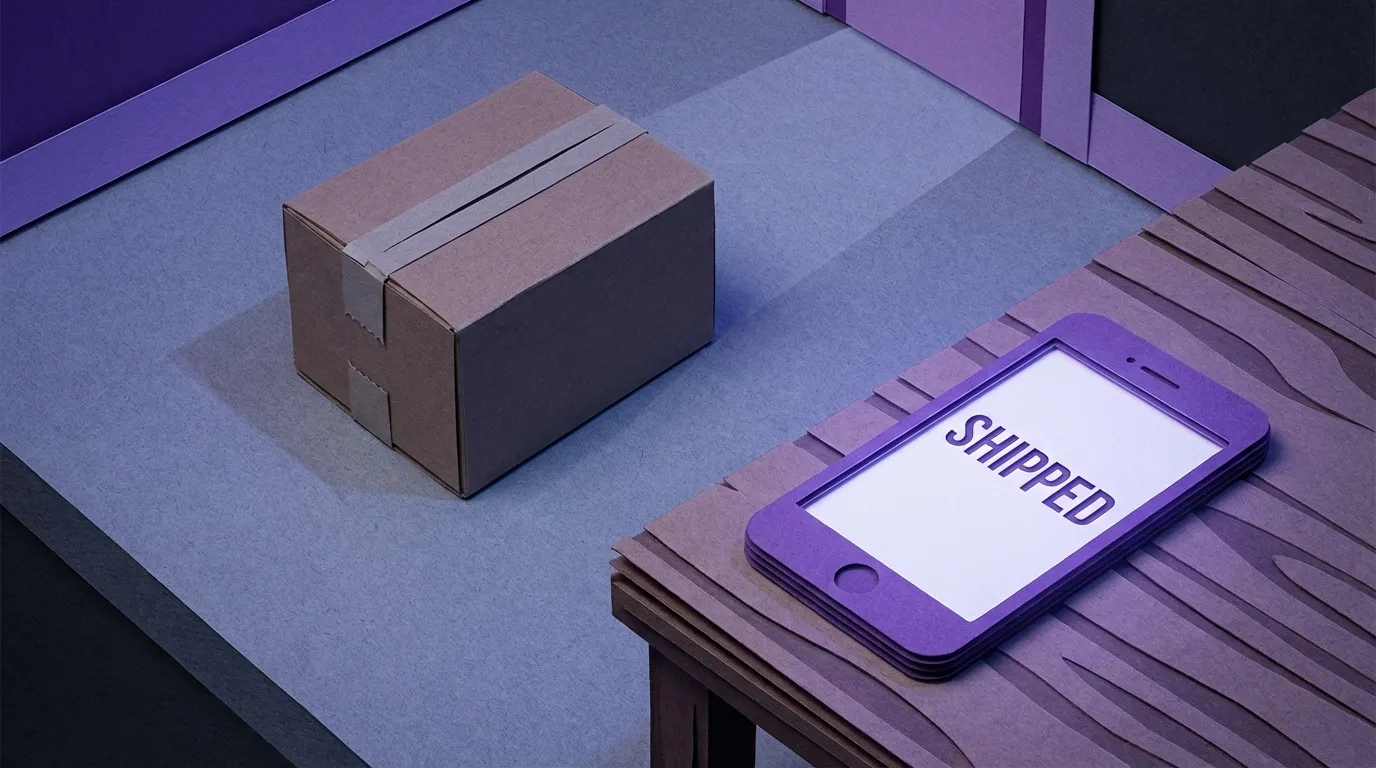
You order something online. You get a notification: "Your order has shipped!" You click the tracking number and discover the carrier hasn't actually received the package yet. The label was created. That's it. The item might ship today, or tomorrow, or the day after. The notification was technically triggered by the system, but it doesn't reflect reality.
Nobody calls customer support over this. Nobody writes a complaint. But a tiny deposit of doubt gets made in the trust account. "Shipped" didn't mean shipped. What else doesn't mean what it says?
This kind of micro-dishonesty isn't intentional. It's what happens when systems don't talk to each other. Someone printed tomorrow's orders. A status updated before the handoff actually occurred. The warehouse and the notification system are operating on different timelines, and the customer is the one who notices the gap.
Now compare that to the company where you order overnight delivery and the package ships the same day. The order status updates in real time. You get a notification when it arrives. Everything matches. Everything is true.
You don't think "their systems are well-integrated." You think "these people have their act together." And once you think that about a company, you extend them credit in every other interaction. You assume their customer service is good. You assume their products are solid. You give them the benefit of the doubt when something does go wrong — because you trust them.
That trust wasn't built by a branding exercise. It was built by a shipping notification that told the truth.
Southwest Airlines Was Flying the Same Planes
Years ago, Southwest Airlines did something that most of their competitors thought was crazy: when you called them, a person answered the phone.
Not a phone tree. Not an IVR system with nine options and a "your call is important to us" message on loop. A human being who could actually help you, on the first call.
Every airline was using the same reservation system — SABRE. They were flying the same 737s on similar routes. The hardware and the core technology were identical. What Southwest did differently was organize the backend so that the first person who picked up had the access and the authority to solve your problem.
Customers didn't experience this as a technology decision. They experienced it as "these people care about me." That perception — built entirely by operational design — became one of the most durable competitive advantages in the airline industry.
The planes were the same. The system was the same. The customer experience was completely different. Because one company designed the operation around the customer's experience of it, and the others designed it around their own internal convenience.

You Can't Fake Confidence
There's a thing people say in sales: you can't fake confidence.
I believe it. And here's where the back office connects to revenue in a way that doesn't show up in any efficiency report.
The salesperson who lost the last two deals — one because the quote came back late, one because it had a pricing error — carries that into the next conversation. They might not say anything about it. But the slight hesitation when the prospect asks "can you turn this around by Friday?" The half-second pause before they commit to a number. The hedge in their voice when they say "I'll make sure that happens."
The prospect picks up on all of it. Not consciously. But they walk away with a vague sense that something wasn't quite solid.
Now picture the rep whose quotes go out accurate and fast, whose operations team delivers on what was promised, whose customer service handles issues without the rep ever hearing about it. That rep doesn't hope things will work out. They know. And that knowing comes through in every interaction — the posture, the speed of the answer, the willingness to commit.

The back office didn't close that deal. But the back office is the reason the rep had the confidence to close it. The customer never saw the system. They saw the salesperson. And the salesperson was a direct reflection of whether the operation behind them was trustworthy or not.
Nobody Leaves Over One Thing
It's exceedingly rare for a customer to end a relationship over a single issue.
What ends relationships is the steady repetition of small, unaddressed problems. The invoice that's wrong two months in a row. The status update you have to ask for three times. The feeling that every interaction requires you to re-explain who you are and what you need.
That last one is particularly corrosive. When a customer calls and realizes they know more about their own problem than the employee they're talking to — and then has to retell the whole story to the next person, and the next — the message is clear. Nobody here is keeping track. My business isn't important enough to remember.
I've seen the opposite too. I've seen companies that mess up regularly but are praised by their customers. The difference? They're always there to fix it. When something goes wrong, they own it, they're fast, and the customer feels taken care of. That earns more loyalty than a flawless process that the customer never gets to see in action.
But here's the key: being great at recovery requires knowing what happened. If your systems are disconnected — if the person answering the phone has to dig through three tools to figure out the customer's situation — even your recovery is slow and clumsy. The willingness to help is there. The ability to help quickly isn't.

If You Fear the Call, Your Back Office Isn't Clean
There's a pattern I've seen at companies where the owner or ops lead subtly avoids customer contact.
They don't dodge it obviously. They just don't seek it out. They let emails sit a little longer than they should. They let the account manager handle the "relationship calls." They aren't reaching out proactively.
And the reason, when you dig into it, is almost always the same: they don't trust what they'll find. They're worried about being surprised. Blindsided by a problem they should have known about but didn't, because the system didn't surface it. So they stick their head in the sand and hope the customer doesn't bring it up.
The cost of that avoidance isn't just the occasional lost deal. It's everything you never hear. The customer might not care about the issue you're dreading. They might have a completely different concern — one you could easily address — that's been simmering for months. Or they might have a new project they'd give you if you were in the conversation. But you're not in the conversation, because you don't trust your own operation enough to show up.
You don't need a portal to fix this. You don't even need new software. You need the list of questions your customers keep asking and a plan to get ahead of them. That's it. Once you stop reacting and start anticipating, the fear goes away — because you already know what they're going to ask, and you already have the answer.
The Sunny Day Problem
MSPs — managed service providers — have a version of this that's almost poetic in how self-defeating it is.
A good MSP comes in, cleans up the mess, stabilizes the systems, and eliminates the constant escalations that were driving management crazy. Everything runs smoothly. No more fires. No more emergency calls.
And then the client starts to wonder: what are we paying these people for?
Because the MSP was focused entirely on fixing problems, they never built the relationship that survives the absence of problems. The client doesn't see the monitoring, the patching, the quiet prevention work that keeps everything stable. They just see a monthly bill and a phone that doesn't ring.
Some of them leave. And some of them come right back when the symptoms return. But the ones who leave didn't leave because the MSP was bad. They left because the MSP's value was invisible.
This applies to every business, not just MSPs. When things are smooth, your customers notice — but only if you're present enough for them to associate the smoothness with you. If you disappear when there's nothing to fix, you lose the relationship that all that good operational work should have earned you.
Even on sunny days, you need to reach out. Not to sell. Not to fix. Just to be there — so that when the customer thinks about why things are going well, they think of you.
The Compound Effect
Every one of these moments is small. A shipping notification. A quote turnaround time. A phone call where someone knew the answer. A proactive check-in when nothing was wrong.
Individually, none of them matter much. Collectively, they are the entire reason your customers stay, refer, and pay premium prices without negotiating.
The companies I've worked with that have this figured out don't talk about their back office to customers. They don't mention their ERP or their CRM or their integration architecture. The customer just experiences something that feels easy, fast, and reliable — and they attribute it to the people, not the systems.
That attribution is exactly right. The systems didn't build the relationships. The people did. But the systems gave the people the time, the information, and the confidence to show up as the best version of the company. Every call, every quote, every follow-up.
Your customers can't see your back office. But they can feel it — in every interaction, in every response time, in every moment where you either knew the answer or didn't.
They'll never tell you "your operations are impressive." They'll just keep coming back. And they won't be able to explain exactly why.
Keywords
Related Articles
How a 40-Person Company Runs Like a 100-Person Company
Stop letting value leak out of your business. Learn how to build systems that amplify your team's ta...
Your People Are the Integration Layer (And It's Costing You Everything)
Is your team acting as human middleware? Discover the 6 hidden patterns of integration failure costi...
One System, One Truth: How a Right-Sized CRM Replaces Spreadsheet Chaos
Ditch spreadsheet chaos! Discover how a right-sized CRM can streamline your 20-80 person company, bo...