
Stop Writing Articles. Start Having Conversations.
Learn how to transform your content marketing by replacing the blank page with an AI-driven interview process that captures your authentic voice and insights.
Every business owner I know has the same relationship with content marketing: they know they should be doing it, they hate doing it, and the stuff they produce when they force themselves to sit down and write reads like it was squeezed out under duress. Because it was.
Here's the thing — you don't actually have a writing problem. You have an extraction problem.
You know your business better than anyone. You've spent years — decades, in my case — solving real problems for real people. You have stories, opinions, and hard-won insights that your prospects would genuinely benefit from reading. The knowledge is there. It's just trapped in your head, and staring at a blank Google Doc is the worst possible way to get it out.
 So we stopped writing articles. We started having conversations instead. And the quality went through the roof.
The Blank Page Is the Enemy
I've been building custom software for businesses for over forty years. I can talk for an hour about why off-the-shelf CRMs fail companies with 50 employees, or why scattered data across multiple systems is the silent killer of growth, or why the build-versus-buy question is fundamentally the wrong question to ask. Put me in a room with a business owner who's living one of those problems and I'll give you material for three articles.
But sit me in front of a cursor blinking on a white screen? Suddenly I'm writing "In today's competitive landscape..." like every other CEO blog post you've ever skimmed and forgotten.
The problem isn't a lack of things to say. It's that writing and thinking are two different cognitive modes, and trying to do both at once produces mediocre results at both. When you're writing, you're worried about sentence structure and flow and whether you've repeated a word too many times. When you're thinking, you're connecting ideas, recalling stories, building arguments. Doing both simultaneously is like trying to drive and read a map at the same time. You'll get somewhere, but probably not where you intended.

What If You Just Talked?
Here's the method. It's simple to describe, and it works better than anything else I've tried.
You open a conversation with an AI — Claude, in my case — and you give it a job: interview me about this topic until you have more material than we need, then write the article. You provide your topic, your bullet points, your target word count, and ideally two or three articles you've already published so it can match your voice.
Then the AI starts asking questions. Not generic ones. Specific, pointed questions that push you to go deeper than you would on your own. "What's the typical wake-up call moment for an owner?" "Can you give me a number on that?" "What does that actually look like on a Tuesday morning?"
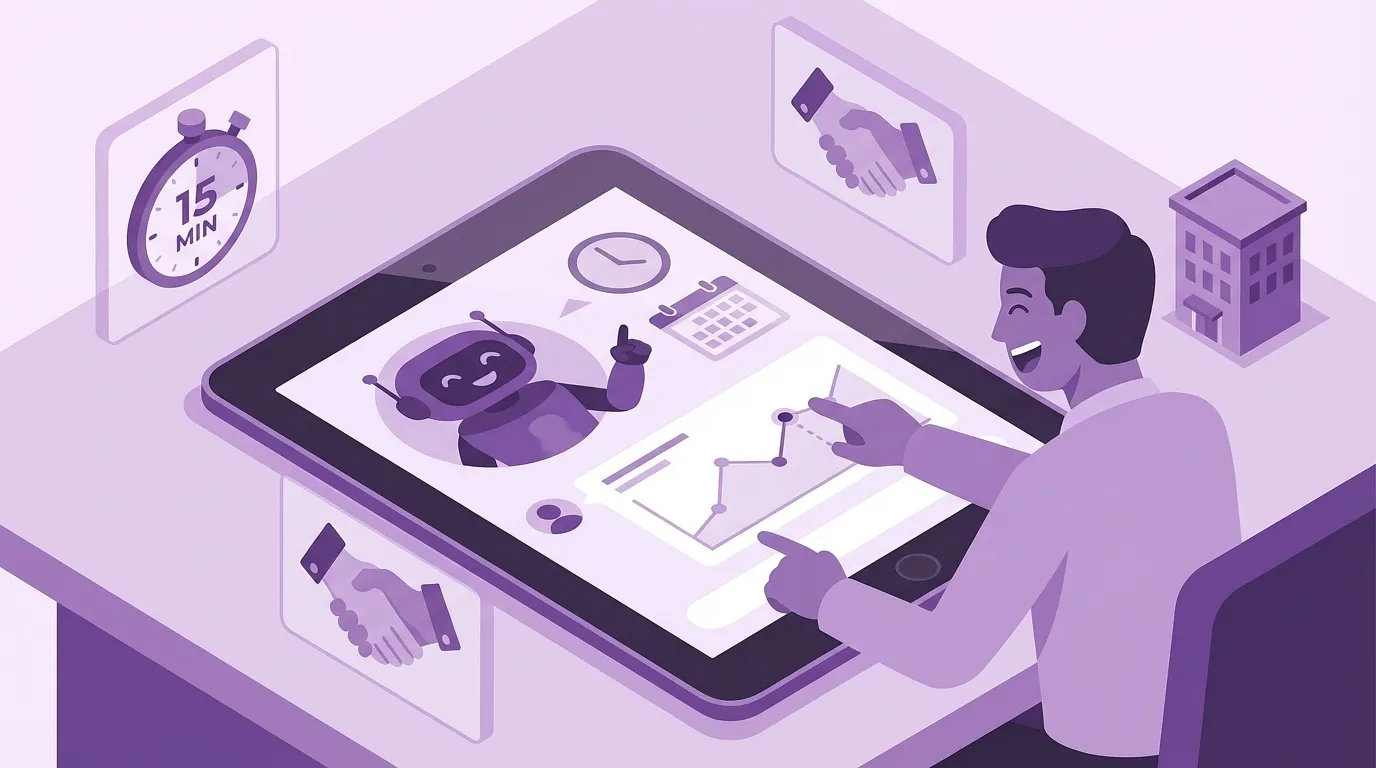
And because you're answering questions — not writing prose — you talk the way you actually talk. You tell stories. You get specific. You say things like "I had a client who was spending 120 hours on a process that we got down to 15 minutes" because that's what happened, and when someone asks you about it directly, that's what comes out.
The AI captures all of it. Then it assembles a draft — but the substance is yours. Your stories, your numbers, your examples, your point of view. The AI didn't come up with any of it. It organized what you said into something readable. Not generic thought leadership. Your actual thoughts, structured.

Why This Works Better Than Writing From Scratch
The interview format solves three problems at once.
First, it solves the blank page problem. You don't have to figure out what to write, because someone is asking you. The cognitive load shifts — instead of generating and organizing and wordsmithing simultaneously, you're focused on one thing: answering the question in front of you. That's still work. But it's work you're good at, because you're drawing on what you actually know.
Second, it produces better raw material. When you write from scratch, you self-edit in real time. You skip the story because you're not sure how to transition into it. You round down the numbers because you don't want to sound like you're bragging. You smooth out the opinions because you're worried about how they'll land. In an interview, you just say what you think. The editing happens later, on material that already exists. That's a much easier problem than generating polished prose from nothing.
Third — and this is the one that surprised me — it captures your actual voice. When I write carefully, I sound like an article. When I answer questions off the cuff, I sound like myself. And it turns out that "myself" is a much more compelling writer than the version of me who's trying to sound like a writer. The AI picks up your sentence rhythms, your favorite phrases, the way you build an argument. It learns that you lead with pain, not definitions. That you use client names. That you end with something the reader can actually do Monday morning.
The Exact Prompt
Here's what I paste into a new conversation every time we write an article. Feel free to steal it.
THE PROMPT — copy everything below the line
We are writing a well-thought-out article together. Here's how this works:
STEP 1 — SETUP
Ask me three things before we begin:
- What's the topic? (I'll give you a working title and a few bullet points.)
- How long should the final article be? (Default: 1200+ words.)
- Who's the audience? (Job title, company size, what they care about.)
STEP 2 — INTERVIEW
Your job is to interview me until we have MORE raw material than the final article needs. If I need 1200 words, you should pull at least 2000–3000 words of substance out of me. That gives us room to cut, tighten, and pick the best parts.
Ask 2–3 questions at a time, grouped by theme. Don't overwhelm me. Follow this arc:
- PAIN — What's broken? What's frustrating? What's the cost of doing nothing?
- STORY — Specific examples, real numbers, before/after scenarios.
- SOLUTION — Grounded in "what actually happens," not marketing language.
- OBJECTIONS — What would a skeptic say? What's the pushback?
- TAKEAWAY — If the reader remembers one thing, what is it?
If I give you a vague answer, push back. Say "Can you give me a number?" or "What does that actually look like on a Tuesday morning?" If I skip a question, ask it differently later. After each round, briefly summarize what you've captured and what gaps remain.
STEP 3 — WRITING
When you have enough material, tell me. Then write the article with these rules:
- Write in MY voice — first person, conversational, grounded in experience.
- Lead with pain, move through story, land on insight.
- Use the specific details from the interview — names, numbers, scenarios.
- No bullet-point lists in the body. Write in prose and paragraphs.
- Section headings should be conversational, not corporate.
- The opening paragraph should hook with a recognizable problem, not a definition.
- Close with something actionable — not a generic CTA.
- Every paragraph should earn its spot.
- If any previously published articles are attached, match their tone and specificity.
STEP 4 — REVIEW
After the first draft, ask me what to change. Expect at least one revision round.
That's it. The entire system fits in a single prompt.
Making It Work: What I've Learned
Attach previous articles. This is the single biggest lever for quality. The AI will match your tone, your level of specificity, your tendency toward analogies (or away from them), how long your paragraphs run, whether your section headings sound like newspaper headlines or casual questions. Without examples, you'll get competent but generic. With two or three of your published pieces, you'll get something that sounds like it belongs on your site.
Answer in your natural voice. Don't type polished paragraphs in response to the interview questions. Talk the way you'd explain it to a peer over coffee. The rougher your answers, the more authentic the final article. The AI can clean up grammar and structure. It can't add authenticity that isn't there.
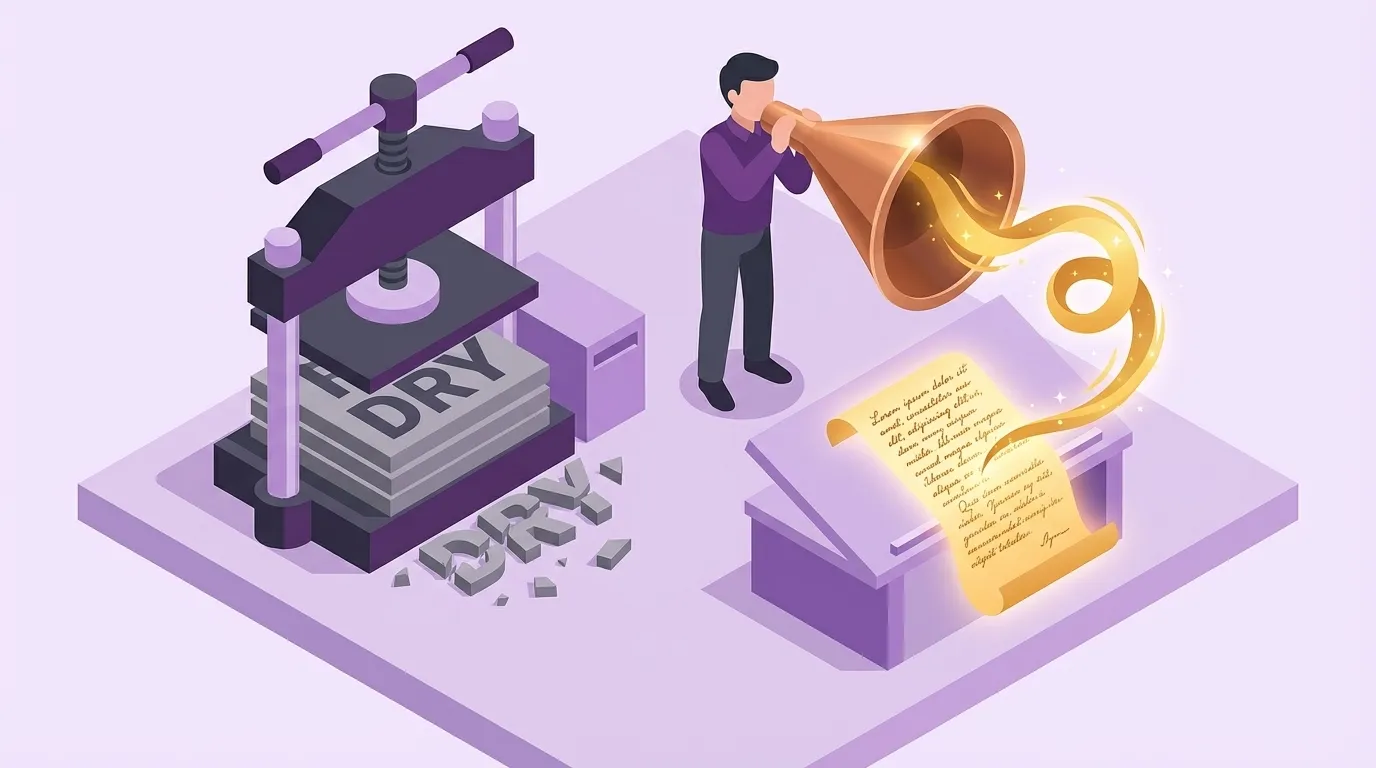
Don't skip the objections round. When the AI asks "what would a skeptic say?", that's where some of the best material comes from. It forces you to articulate why the obvious alternatives don't work, why the status quo is more expensive than it looks, why the thing that sounds too good to be true actually isn't. Those paragraphs are often the ones that convert a reader into a prospect.
Push back on the AI. If it asks a question that doesn't fit your angle, say so. If it summarizes something wrong, correct it. If it's heading somewhere that doesn't match what you had in mind, redirect. The interview is collaborative. You're the subject matter expert. The AI is good at asking questions and structuring what you give it — but you're the one doing the heavy lifting.
Have your outline ready. You don't need a finished outline, but walking in with a working title, five to seven bullet points, and one strong story will cut the interview time in half and dramatically improve the result.
The Numbers
A typical article takes me about two hours from start to finish. Over an hour of that is the interview itself — a real conversation where the AI pushes me to go deeper, get more specific, and defend my positions. That produces two to three thousand words of raw material, which is more than the final article needs. Then comes the editing: cutting the parts that don't earn their place, tightening the language, making sure the arc holds. That's another thirty to forty-five minutes.
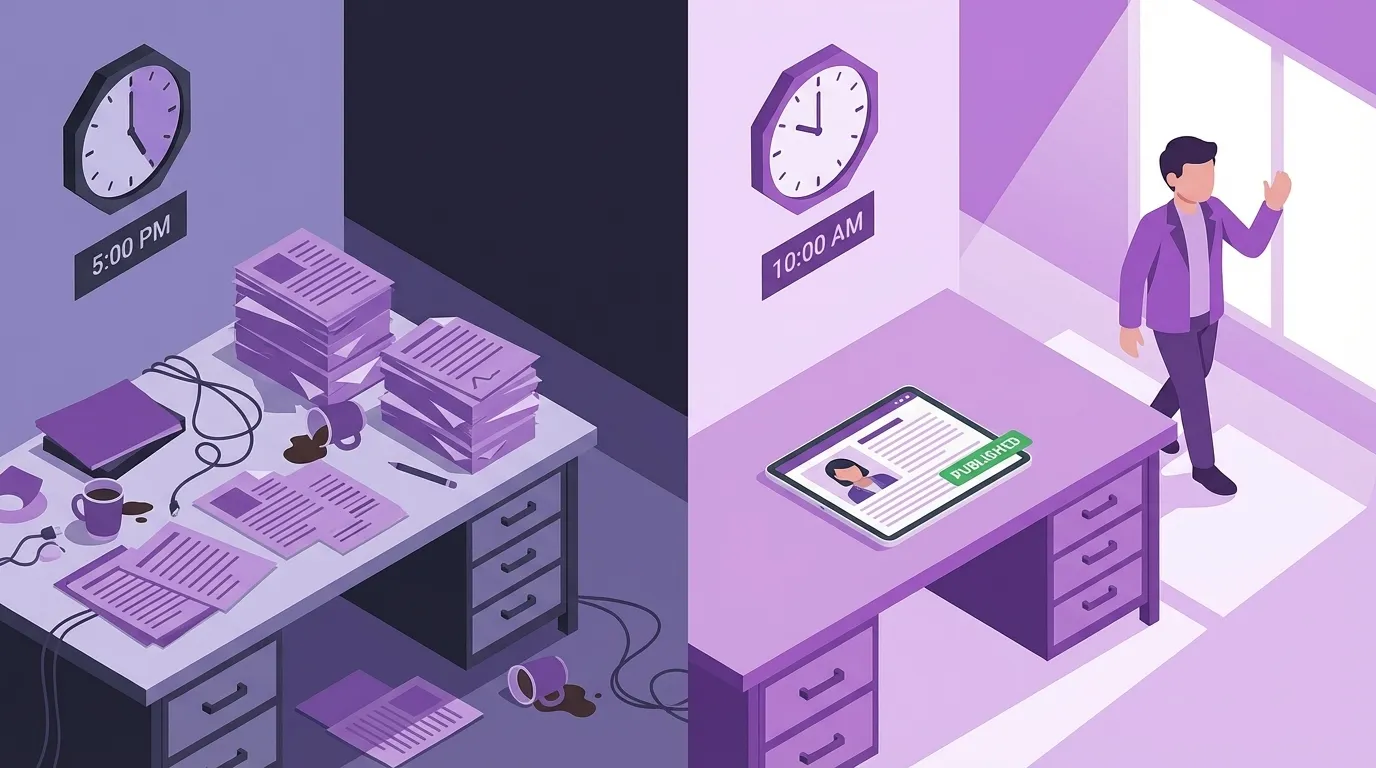
That's not fast. It's not supposed to be. What changed isn't the time — it's where the time goes. I used to spend two hours staring at a screen trying to simultaneously think and write and edit. Now I spend that same time thinking deeply about the subject and then shaping the result. The output is better because the process respects how expertise actually works: you know more than you can write down in one sitting, and a good interviewer pulls out things you wouldn't have thought to include.
We've published over a dozen articles this way. The tribal knowledge piece came from an interview about what happens when a key employee leaves. The scattered data article came from a conversation about why sales teams feel the pain first when systems don't talk to each other. The customer portals article came from a series of questions about what customers are actually calling about — and the answer was that eighty percent of it was just information retrieval, stuff the company already had in a system somewhere.
None of those details would have made it into a written-from-scratch article. They came out because someone asked the right questions at the right time.
Try It
Pick a topic you could talk about at length — some problem your customers face, some mistake you see over and over, something you wish people understood about your industry. Open a conversation with Claude. Paste in the prompt above. Attach two or three of your best published pieces. Give it your topic and a few bullet points.
Then let it interview you. Answer the questions. Don't overthink it. Go deep when it pushes you — that's where the good material lives. When it says it has enough, let it write.
You'll spend a couple of hours and end up with a 1,200-word article that sounds like you on a good day. Because the thinking is yours — all of it. The AI just made sure someone was asking the right questions while you did it.
Once your article is written, there's still the question of images — and if you've ever spent forty-five minutes browsing stock photo sites for something that doesn't look like a template, you know the pain. We built an open-source tool called Article Image Studio that takes your finished article and generates a set of styled, visually consistent illustrations from it in about five minutes. It's the second half of the pipeline. You can read about how it works — and grab it from GitHub — in Your Article Is Done. Now It Needs Pictures.
Keywords
Related Articles
Your Article Is Done. Now It Needs Pictures.
Stop using generic stock photos. Article Image Studio is a free, open-source tool that turns your bl...
Every Article You Write Is Already a Podcast. You Just Haven't Pressed the Button Yet.
Convert your blog posts into professional podcasts automatically. Learn how to use Node.js and Eleve...
The MSP That Asked the Right Question
Learn how MSPs can stay relevant in the AI era by focusing on workflows over tools, building governa...