
Your AI Just Ate Your Customer's Data. And Nobody Noticed.
Is your team unknowingly violating data privacy regulations with AI? Learn how to protect sensitive customer data and avoid costly compliance violations. Read now!

6 min read · Industry Insights
There's a gold rush happening with AI right now. Summarize this contract. Draft that email. Analyze these customer records. The productivity gains are real — and so is the trail of sensitive data being left behind.

Here's the uncomfortable truth most small and mid-sized businesses aren't ready to hear: your team is probably violating data privacy regulations right now, and they don't even know it.
The Copy-Paste Problem
A 2025 security study found that 77% of employees who use generative AI tools are copying and pasting company data directly into them. Not anonymized data. Not test data. Real customer names, real account numbers, real medical information. And over 80% of this activity is happening through personal accounts — completely invisible to IT.
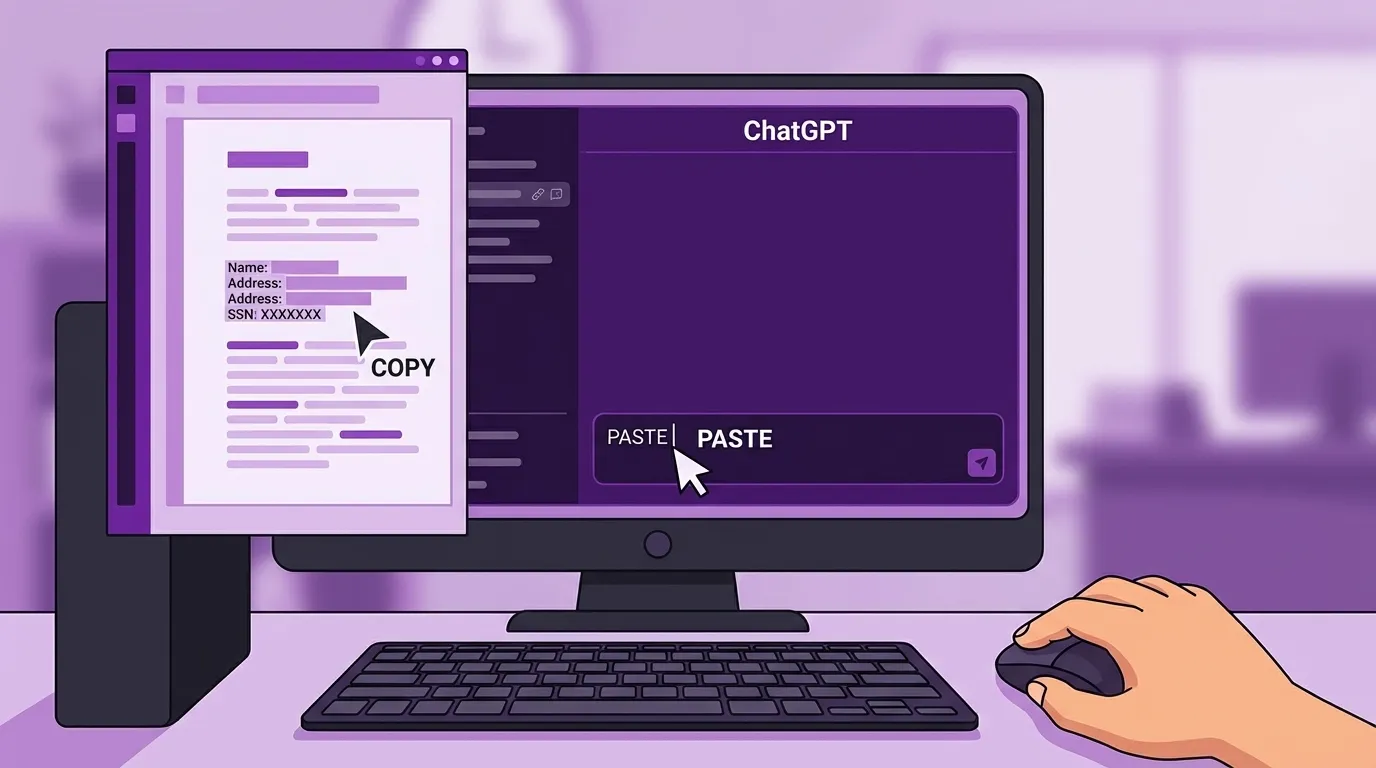
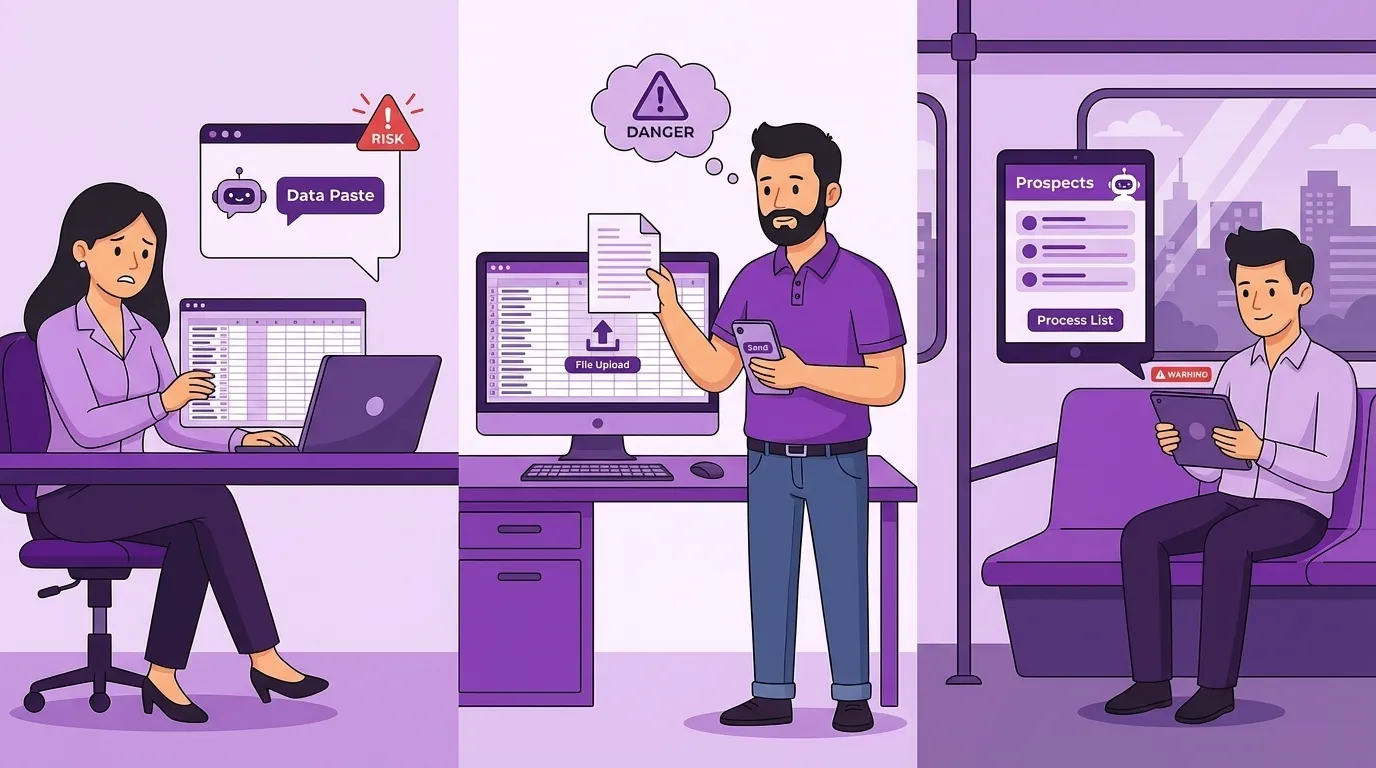
Think about that for a second. Your office manager pastes a client's insurance details into ChatGPT to help draft a letter. Your bookkeeper drops an accounts receivable spreadsheet into an AI tool to "clean it up." Your sales rep feeds a prospect list — complete with contact info and notes — into an AI assistant to write follow-up emails.
None of these people are acting maliciously. They're trying to be more efficient. But they've just sent your customers' private data to a third-party server, with no agreement in place about how that data gets stored, who sees it, or whether it'll be used to train someone else's AI model.
HIPAA Might as Well Be Hippopotamus
If you work anywhere near healthcare data — and more businesses do than realize it — the stakes get dramatically worse. HIPAA isn't a suggestion. It's federal law, with civil penalties up to $50,000 per violation and criminal penalties that include prison time.

Yet nearly half of healthcare organizations still have no formal approval process for AI tools. Only 31% actively monitor how AI systems interact with protected health information. The first major update to the HIPAA Security Rule in 20 years is rolling out, with most provisions becoming mandatory by 2026. And a growing number of states are layering on their own AI-specific regulations — Colorado, Texas, and Utah have already passed comprehensive laws, with more on the way.
Here's what trips up most SMBs: you don't have to be a hospital to fall under HIPAA. If your business handles protected health information on behalf of a covered entity — as a billing service, a staffing company, a software vendor, a benefits administrator — you're a business associate, and the same rules apply.
That means when your employee pastes a patient name and diagnosis into a consumer AI tool to draft a prior authorization letter, you've just committed a HIPAA violation. Full stop. The fact that "everybody does it" is not a defense.
The SaaS Trojan Horse
It's not just the obvious stuff. A subtler risk is the AI features quietly appearing inside tools your team already uses. Your CRM adds an "AI assistant." Your email platform starts offering "smart compose." Your project management tool rolls out "AI-powered insights."
Each one of these features may be sending data to a third-party model. And unless you've checked the terms of service — specifically, whether the vendor signed a Business Associate Agreement and whether your data is being used for model training — you probably don't know where that data ends up.
A vendor's marketing page saying "we take security seriously" doesn't tell you much. The question is whether there's a BAA in place, whether data is encrypted in transit and at rest, whether the vendor contractually guarantees your data won't be used for training, and whether you can actually audit any of it.
If the answer to any of those questions is "I don't know" — you have a problem.
The Scenarios That Keep Compliance Officers Up at Night
Let's make this concrete with some anonymized examples of things that happen regularly at companies like yours:
The helpful office manager. She copies a patient's full medical history into an AI chatbot to generate a summary for an insurance appeal. The data now lives on a third-party server. There's no BAA. She has no idea the tool's terms of service say user inputs may be used to improve the model.
The well-meaning developer. He's building an internal dashboard and feeds real customer records into an AI coding assistant to help generate sample queries. Actual PII — names, addresses, Social Security numbers — is now embedded in prompts stored who-knows-where.
The efficient HR manager. She uses an AI writing tool to draft employee termination letters, pasting in performance reviews, medical leave records, and salary information. All of it is now outside the company's security perimeter.
Each of these people was trying to do their job better. And in each scenario, the company is now exposed to regulatory penalties, lawsuits, and a breach notification obligation they may not even know exists.

What You Can Actually Do About It
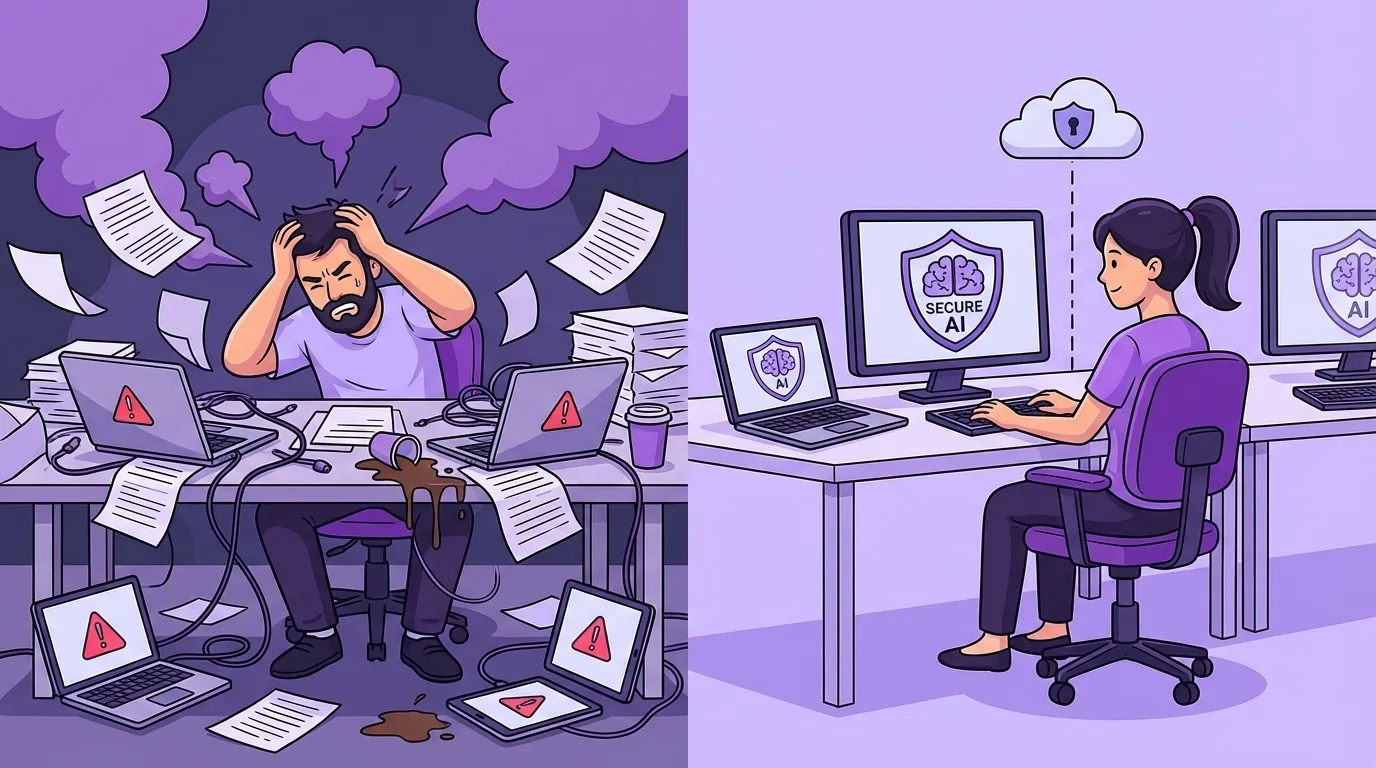
Here's what most companies learn the hard way: policies alone don't work. You can write the most beautifully worded acceptable-use policy in the history of corporate compliance, laminate it, frame it, and hang it in the break room. Most of your employees will still paste customer data into ChatGPT tomorrow morning, because the AI makes them faster and the policy doesn't.
This isn't a discipline problem. It's a tooling problem. If you don't give people an approved way to use AI with guardrails, they'll find an unapproved way without them.
Give them the tools, or they'll get their own. The most effective thing you can do is provide AI capabilities inside the systems your team already uses — with the compliance layer built in. An AI assistant embedded in your CRM that only sees the data it needs to see, that operates under a BAA, that auto-deletes data after use, and that doesn't send anything to a third-party training pipeline. That's not a policy. That's architecture. And architecture is enforceable in a way that a handbook rarely is.
Make the right thing the easy thing. If the compliant path is harder or slower than the non-compliant path, you've already lost. The goal is to make the secure option so seamless that people don't have a reason to open a browser tab and paste data into a consumer tool. When your platform auto-redacts sensitive fields before they hit an AI layer, or auto-deletes unused data on a schedule, compliance becomes invisible — and that's when it actually sticks.
Audit the tools you already have. Any SaaS product your company uses that has quietly added AI features needs to be re-evaluated. Do they have a BAA? Do they use your data for training? Where is the data processed and stored? If they can't answer these questions clearly, that's your answer. The AI feature your vendor shipped last quarter might be the biggest compliance hole in your stack, and you didn't even opt into it.
Brace for the regulatory wave. The HIPAA Security Rule update is just the beginning. Twelve states have already enacted AI-related healthcare legislation, and more are coming. The FTC is paying attention. The DOJ has new rules restricting bulk transfers of sensitive personal data. The compliance landscape a year from now will look nothing like today — and "we didn't know" has never held up well as a defense.
The Bottom Line
AI is a powerful tool. But so is a chainsaw, and you wouldn't hand one to someone without training and safety equipment.
The companies that will do well with AI aren't necessarily the ones that adopted it fastest. They're the ones that adopted it thoughtfully — with proper vendor agreements and systems designed to keep sensitive data where it belongs.
If reading this gave you a knot in your stomach, good. It means you're paying attention. Now go find out what your team is actually pasting into ChatGPT, before a regulator does it for you.
PurpleOwl builds custom ERP, CRM, and PSA systems for small and mid-sized businesses — with data governance baked in from the architecture up, not bolted on as an afterthought. If you're worried about where your data is going, let's talk.
Keywords
Related Articles
What the Heck Is an MCP, and Does My ERP Need One?
Discover how Model Context Protocol (MCP) lets AI assistants operate your ERP like an employee. Lear...
The MSP That Asked the Right Question
Learn how MSPs can stay relevant in the AI era by focusing on workflows over tools, building governa...
Hey SMB: Your Superpower Is Calling
Your SMB's size is a structural advantage for AI. Learn how to consolidate your business data into o...